All eyes on your traffic. None on your visitors.
Argusmetrics shows where people come from, what they read and what makes them convert, without a cookie, without a consent banner, and without storing a single IP address.
- 0cookies set, so no consent banner
- 0IP addresses stored, anywhere
- 3.1 KBthe whole tracking script, gzipped
Top pagesViews
Arriving nowDaily hash
And youright now
You are in these numbers. This page counts itself. To it you are one pageview on /, from a country, with a hash that expires at midnight.
Unless your browser sends Do Not Track. Then you are not here at all.
Paste one line. Watch it arrive.
No build step, no cookie banner to design, no consent flow to wire up. The script goes in the head and the first visit shows up while you are still looking at the page.
<head>
  <title>Shop</title>
  <script defer
    src="https://argusmetrics.io/static/tracker.min.js"
    data-tracking-code="k3x9q2ab"></script></head>
An animation of what happens. Real screenshots are further down.
We see the visit. Not the visitor.
Every analytics product says it respects privacy. Here is the actual reduction: what a browser sends, and the few words of it that are still there a second later. Change who is visiting and watch what happens to the hash.
What arrivestoday, 14:02
- IP address
- 81.224.17.
42 - cut to 81.224.17.0/24, hashed, then thrown away
- User-Agent
- Mozilla/5.0 (Windows NT 10.0; Win64; x64) AppleWebKit/537.36 (KHTML, like Gecko) Chrome/126.0.0.0 Safari/537.36 family and major version kept, the string is not
- Accept-Language
- sv-SE,sv;q=0.9,en-US;q=0.8,en;q=0.7 first language kept, the list is not
- Cookie
- none sent, none set
What is storedone row
7c1e…a94fa hash that is only good until midnightThe address is cut down, hashed together with the browser, your domain and today's salt, and discarded. There is no column to keep it in.
The hashes shown are illustrations; the mechanism is not. It is in the source, with the tests that check it: read the code, or the plain-language version in Privacy by design.
The watchman weighs 2.9 kilobytes.
Analytics should not be the heaviest thing on the page. These bars are to scale: the script each product asks you to embed, gzipped, over the wire.
Measured 7 October 2026, our own script again on 17 November 2026. About 50 times smaller than the Google tag, and yes, Plausible's is smaller still.
One page that answers the actual questions.
Where did they come from, what did they read, did they do the thing. Real screenshots, running on demo data.
The day, the month, or the hour it happened.
Visitors, visits, bounce rate and time on site, with the graph in your own time zone and a note on the day you sent the newsletter.
- Any date range, by day or by hour
- Compare with the previous period or last year
- Notes on the timeline, for your team
- Anomaly detection against your own baseline
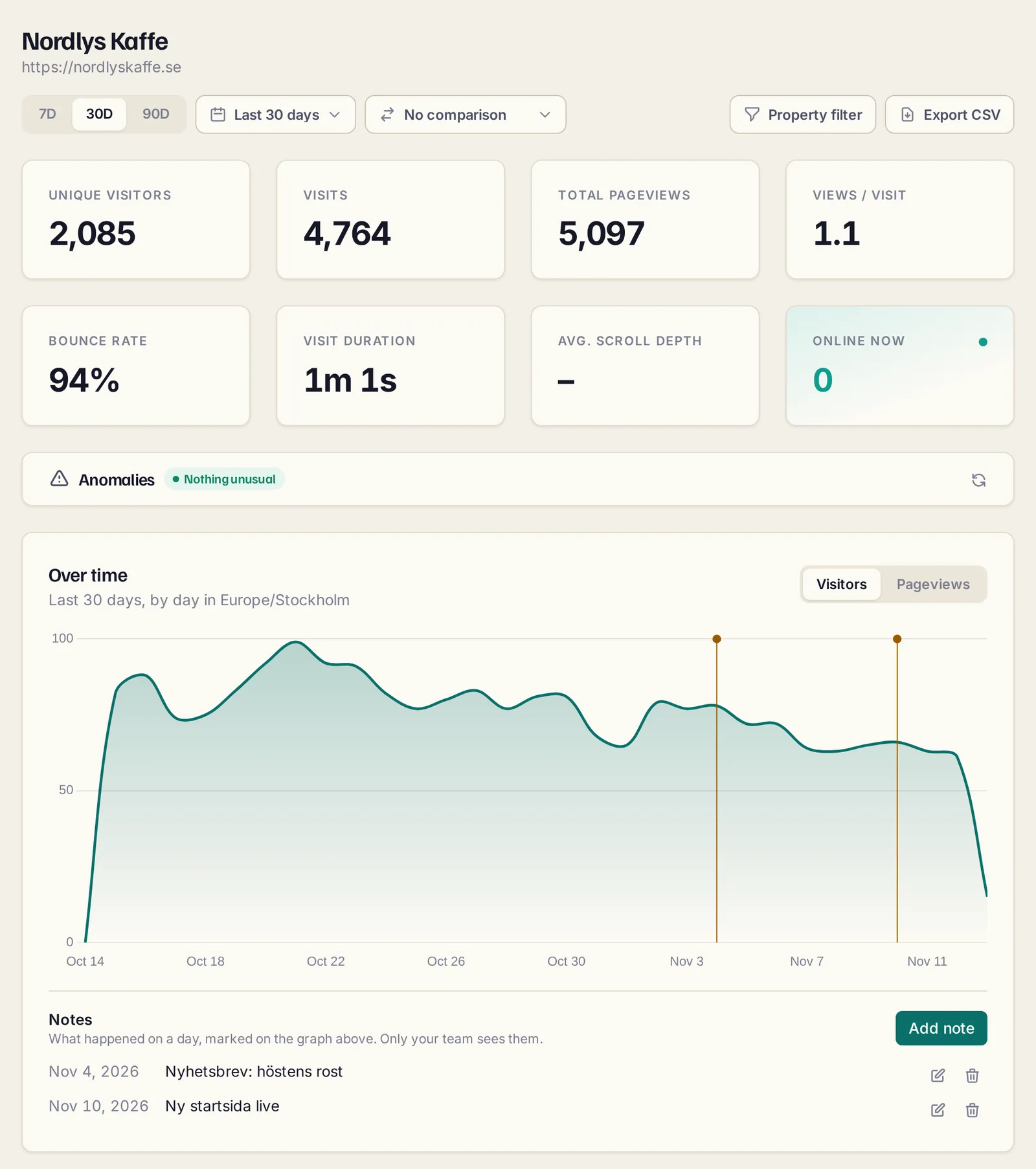
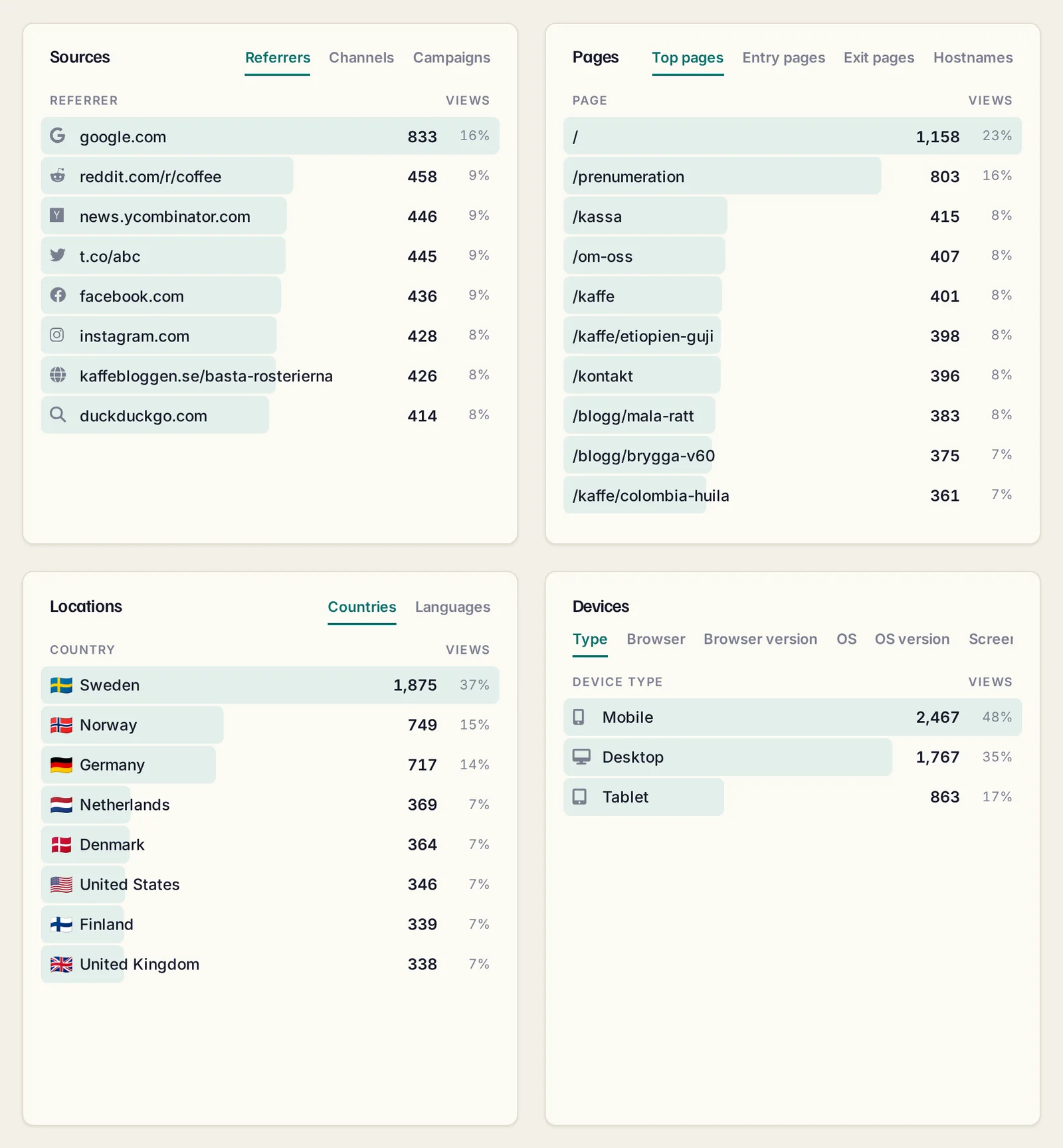
Four cards instead of fifteen.
Referrers, channels and campaigns. Top, entry and exit pages. Countries and languages. Browsers, systems and screens. Each one a tab away.
- UTM campaigns parsed automatically
- Outbound links, downloads and 404s
- Custom events, goals and funnels
- Revenue per product, in any currency
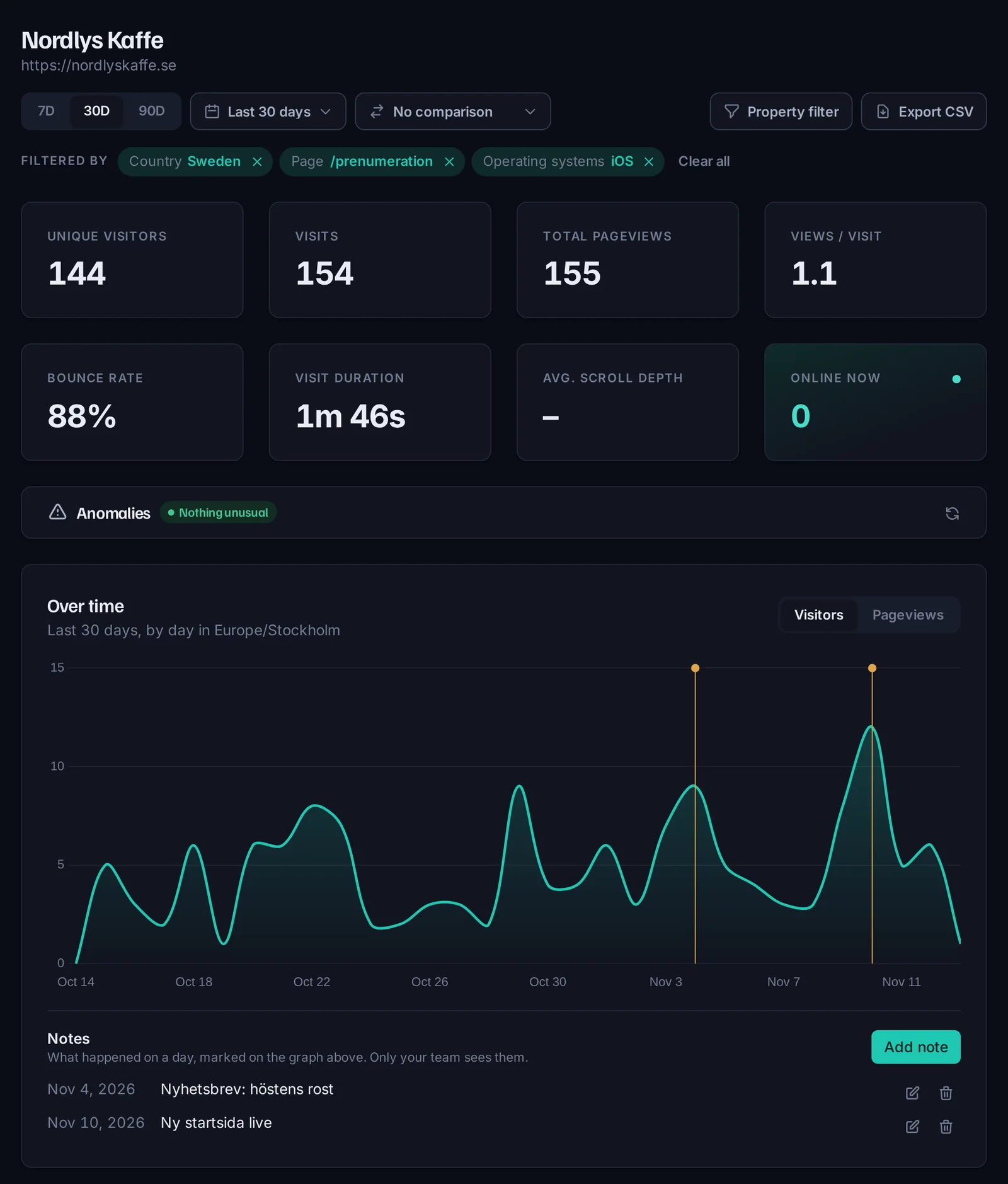
Click a row. The whole page follows.
Swedish visitors on iOS who landed on the subscription page: three clicks, and every number, graph and list is about them.
- Filter by country, page, source, device or system
- Dark mode that follows your system
- Export what you see as CSV
- Share it publicly, with or without a password
From a click to a conversion.
Goals are one line of code, and they count the moment it runs. Signups, purchases, downloads: name the event and it is on the dashboard.
- Conversion rate per goal
- Funnels across several steps
- Revenue attached to the event
Your order
| Goal | Conversions | Rate |
|---|---|---|
| Order placed | 42 | 3.1%3.2% |
| Newsletter signup | 17 | 1.3% |
Also in the box, at no extra charge because there is no charge.
- Goals and funnelswhere visitors drop off, step by step
- Revenue and e-commercepurchases and refunds beside the traffic
- Team rolesowners, admins and viewers
- Two-factor sign-inwith recovery codes
- Email reportsweekly or monthly, no login to read
- Traffic alertswhen something moves against your baseline
- All your sites at onceone combined view
- A plain REST APIexport, integrate, automate
- WordPress and Tag Managerpublished integrations
The honest table, including where we lose.
First the difference your visitors actually feel: the same page with a cookie-based tool, and with this one.
| Argusmetrics | Google Analytics | Plausible | |
|---|---|---|---|
| No cookies | Yes | No | Yes |
| No IP addresses stored | Yes | No | Yes |
| Script size, gzipped | 3.1 KB | ~155 KB | 1.3 KB |
| Custom events | Yes | Yes | Yes |
| Team collaboration | Yes | Yes | Paid only |
| Open source | Yes | No | Yes |
| Run it on your own server | Yes | No | Community Edition |
How it is actually built.
Six things that are true of the code, written specifically enough that you can go and verify each one.
Country, looked up on this server
Truncated to its network
Hashed with today's salt
What is stored
No IP address is ever stored
Not truncated, not encrypted, not anywhere. There is no column for it, and none for the user agent either. Country comes from a database on the server itself, so your visitors' addresses are never sent to a third party.
The visitor hash changes daily
The address is truncated first, IPv4 to a /24 and IPv6 to a /48, then hashed with the browser, your domain and a salt that changes every day. The same visitor tomorrow is a different hash, and everyone on the same network is the same one.
Nothing is written to the visitor's browser
No cookie, no localStorage, no fingerprint. The script sends an event and forgets. That is why no consent banner is needed, rather than a banner being technically avoidable.
The database enforces the separation
Every table holding your data has row-level security policies, and the application connects as a role those policies apply to. A bug in the code cannot show your data to someone else, because the database refuses independently.
Credentials are never stored usably
Passwords, session tokens and API tokens are all hashed. A copy of the database grants access to nothing. Sessions are Secure, HttpOnly and SameSite, and the dashboard loads no third-party scripts at all.
Do Not Track is honoured
A visitor whose browser sends Do Not Track is not recorded at all. Not anonymised, not counted separately. Nothing is written.
the tracking script, gzipped
automated tests, run on every change
third-party scripts, on your site or on this page
None of this has to be taken on trust. The code is public, including the tests that check the claims on this page.
Clone it, set one secret, keep everything.
Argusmetrics runs on a machine you control. It needs Docker and nothing else, and the data never leaves the box it is on.
- Unlimited sites, pageviews and team members. No usage caps, no tiers.
- Sets up its own database and migrates itself on every upgrade.
- Backups and a health endpoint are part of it, not a wiki page.
$ git clone https://github.com/Benbo-se/ArgusmetricsSHCloning into 'ArgusmetricsSH'... done.$ cd ArgusmetricsSH/docker$ cp .env.example .env# then set SECRET_KEY in .env, the one required value$ docker compose up -d postgres backend✔ Container argusmetrics-postgres Healthy✔ Container argusmetrics-backend Started$ curl -s localhost:8020/health{"status": "healthy", "database": "connected", "jobs": {…}}
Keep watch. Keep nothing else.
Add one small script and watch your traffic arrive. No cookie banner required.